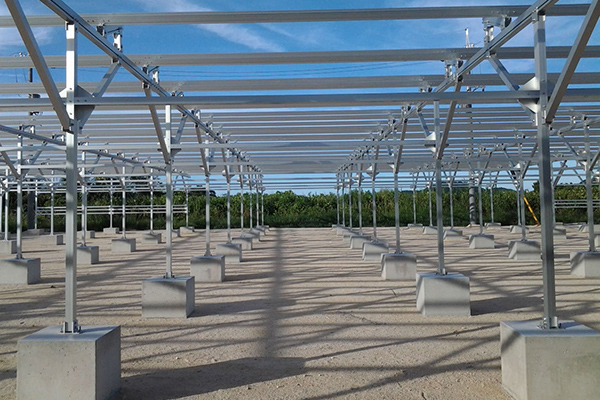
Agricultural solar mounting systems are core supporting structures that connect photovoltaic power generation and agricultural production, creating a highly efficient dual-use model for farmland. They solve the traditional conflict between energy construction and food cultivation, turning ordinary farmland into productive bases that generate both crops and clean electricity.
Made of high-strength aluminum alloy and hot-dip galvanized steel, these mounting systems feature outstanding corrosion resistance, wind resistance and snow load capacity, ensuring a service life of up to 25 years in harsh outdoor environments such as humidity, salinity and extreme weather. Their adjustable height and tilt angle design not only maximizes solar absorption for higher power generation efficiency but also reserves enough space for farming machinery and crop growth, avoiding shading that affects photosynthesis.
These systems support a variety of agrivoltaic scenarios, including farmland planting, greenhouse shading, fish-pond aquaculture and hilly wasteland transformation. The modular and pre-assembled structure simplifies on-site installation, shortens construction periods and reduces labor costs for farmers. By elevating solar panels, the systems provide proper shading for heat-sensitive crops, lower soil water evaporation and help improve crop yields in arid areas.
Beyond land efficiency, agricultural solar mounting systems bring stable economic benefits. Farmers can earn additional income from grid-fed electricity while maintaining traditional planting and breeding, and the generated power can support irrigation, ventilation and lighting in agricultural facilities. The flexible design also adapts to different terrains, making large-scale agrivoltaic projects possible in mountainous and uneven areas.
As global efforts to promote low-carbon agriculture and renewable energy accelerate, agricultural solar mounting systems have become an indispensable part of smart farming. They balance energy development and food security, reduce carbon emissions and drive the transformation of traditional agriculture toward sustainability, intelligence and high efficiency.