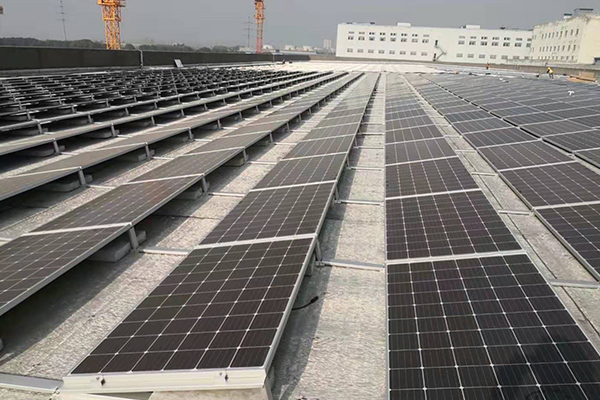
Flat roof solar mounting systems have emerged as a cornerstone of urban solar adoption, addressing the space constraints of cities by leveraging underutilized rooftop areas. Designed for low-slope (1-10°) roofs common in commercial buildings, industrial facilities, and warehouses, these systems balance structural stability, installation flexibility, and energy optimization—critical for maximizing solar project returns.
The core system types cater to diverse roof conditions: Ballasted (non-penetrating) systems use concrete/steel weights to secure arrays without drilling, preserving roof waterproofing and warranty integrity . Ideal for concrete or membrane roofs, they distribute loads evenly (25-40 kg/m²) and support 5-15° tilt angles for optimized sunlight capture . Penetrating (mechanical) systems anchor directly to roof structures via bolts, offering superior wind resistance (up to 180 km/h) for sloped or high-wind zones, though requiring precision waterproof sealing . Hybrid systems combine ballast and penetration for balanced weight efficiency and stability, suitable for seismic-prone regions .
Advanced designs integrate galvanized steel or aluminum components (G90 coating) for corrosion resistance, while adjustable rails enable 10-30° tilt angles—balancing 92-98% peak efficiency with wind load mitigation . Key technical features include compliance with ASCE 7-22 wind standards, 3-axis laser alignment (±1° tolerance), and compatibility with TPO/PVC/metal roofs . Installation is streamlined, with ballasted systems requiring no curing time and penetrating models featuring torque-controlled bolting for consistency .
Beyond space efficiency, these systems drive sustainability by reducing carbon footprints and energy costs. They support scalable deployments—from small commercial arrays to large industrial projects—while minimizing roof disruption. As urban renewable goals accelerate, flat roof solar mounting systems stand as a pragmatic choice, bridging structural safety, installation versatility, and long-term energy productivity for modern built environments.